

When I was very young, I believed that the world must be filled with wonderful and exciting people. People who cared about the same things I cared about, people who were passionate about their pursuits, who were electric to be around. I believed that all I had to do was go out into the world and these people would be easy to find.
But I was in for a rude shock. Yes, there are wonderful people out there—and many are wonderful in ways that I’d never expected. But what I found was that even among these people, very few were “my people”—people who shared my most fundamental values, and among whom I felt at home. The closest I came to finding “my people” for a very long time was, oddly, in Japan. Among the rest of the world, almost nobody I met shared my core values, or had a real passion for any of the things I considered important. I had friends, but what I craved more than anything else was community. I was starved for a community of like-minded people, among whom I felt “at home.”
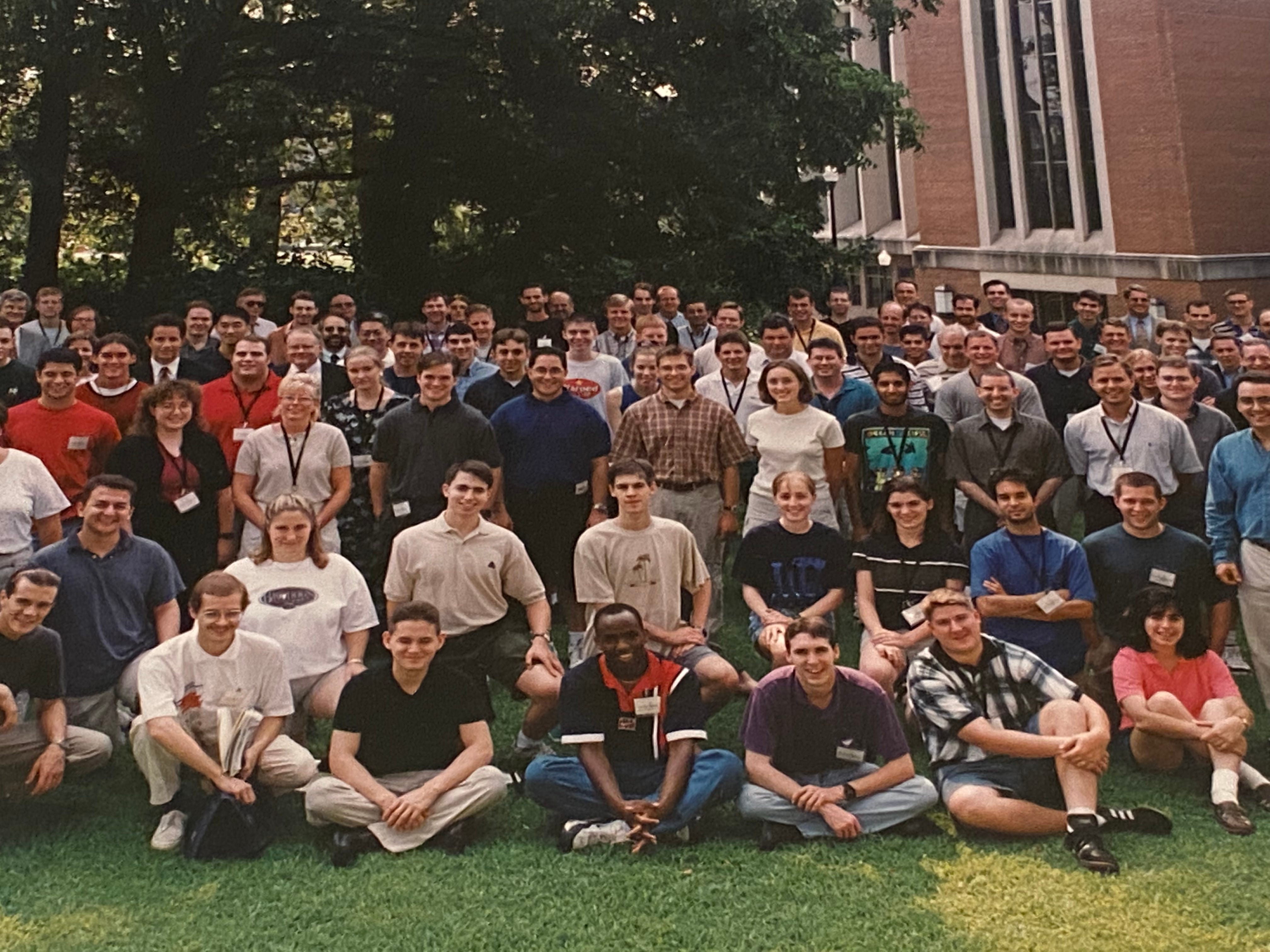
In 1999, while I was working for The Asian Wall Street Journal in Hong Kong, I decided to attend the Mises Institute’s week-long “Mises University.” I had heard about it before, but had never had the free time nor the burning desire to attend. What I found was something magnificent.
It was intellectually stimulating and intense, which I had expected. What I hadn’t anticipated was what it would be like to have in-depth conversations with people who already understood that the state was the problem, and were ready to discuss what comes after that recognition. I wasn’t ready for how positive and good humored everyone would be, how I would laugh until my stomach hurt with the guys from Detroit at lunch time, how I would spend hours in conversations that felt like minutes. I hadn’t anticipated what it would feel like to be “home.”
The space that Lew created when he founded the Mises Institute is more than just a physical place, and much more than just a “think tank.” He created a framework within which a culture based on shared values could emerge organically. And it has.
It is a place where you don’t need to self censor before speaking; if anyone takes issue with what you have to say, they will likely say so in a civilized manner, and a thoughtful discussion will ensue. It is a place where you can leave your laptop on a desk in the library and know—not believe, but know—that it will still be there when you come back. It is a place where God comes up in conversation and nobody snickers or sneers.
It is also a home for many intellectuals who might otherwise have found themselves homeless.
I haven’t told very many people this, and I don’t even know if Lew knows. But there was a time when my father was becoming depressed because he didn’t think anyone was reading what he wrote. He had written two books, and he wrote articles for at least one publication—but at one point, they stopped running them. After my first Mises University (yes, there were more), I suggested to my dad that he send some articles to Lew, and ask if he would want to run them on LewRockwell.com. He did, and Lew did, and LRC became my father’s intellectual home. By the time he passed away in 2019, my father had written around a hundred articles for LRC, as well as numerous blog posts. The Mises Institute re-published his first book, In Restraint of Trade, and went on to publish two more of his books. Much more meaningful to my dad though, was the connection to the many thousands of people who appreciated what he had to say. Even today, I frequently encounter people who tell me how much my father’s writing meant to them—in some cases, that it has changed their entire outlook on life.
That is all thanks to Lew. He quite literally changed my father’s life, and I will be forever in his debt for that.
I have watched over the years as Lew and the Mises Institute have stuck to their principles even when it has cost them financially to do so; I watched as LRC and the Institute were among a very small handful—even among purported libertarians—who spoke out against the Covid-era takeover of our lives; My niece and nephew have attended Mises University, and I hope that my son will too. But even more than that, I hope that my grandchildren, and their grandchildren, will have the opportunity to experience it. I want for the Mises Institute to continue being what it has been since its inception, long into the future, long after I am gone. I want to think that no matter how crazy and dysfunctional the world may become, the Mises Institute will always be there, a sanctuary for people like us.
All of this brings me to the words of Dr. Hans-Hermann Hoppe, from yesterday.
For those who do not know, Dr. Hoppe is the Mises Institute’s Distinguished Senior Fellow. He has been affiliated with the Institute for over forty years, and is the recipient of both the Institute’s Schlarbaum Prize, and its Rothbard Medal. Hoppe is the author of Democracy, the God that Failed, among other books. In the world of Austrian economics, and in the Mises Institute in particular, he is something of a “big deal.”
So when Hans-Hermann Hoppe has something to say about the Mises Institute, I am going to take it seriously.
Yesterday, he published on his own site an article revealing a serious problem with the way the Institute is being run. The article contains within it a letter that Dr. Hoppe and Dr. Guido Hulsmann—one of the Mises institute’s most brilliant scholars, a Senior Fellow with the Institute, and the author of Mises’ biography—wrote to Lew and the Board in August of last year, outlining the nature of this problem. A problem that, in their words “…has the potential to ruin the Institute.”
What is this problem? Briefly, as Hoppe and Hulsmann describe it: The way the Institute is currently organized, the president of the Institute—whoever that may be—is not able to act independently from the Board. The MI’s Academic Vice President, Joe Salerno, is also a permanent member of the Board of Directors. As such, say Hoppe and Hulsmann, “(e)ven though Joe is formally an employee of the Institute, in fact, materially, he is the Vice-Chairman and therefore the hierarchical superior of the President.”
“…Whenever Joe is in fundamental disagreement with the President over any issue that Joe considers important, he can bypass the chain of command and weigh in directly with the supreme authority (the Board and, especially, Lew). Hence, he is in a position to defy, challenge, and overcome virtually any sitting President.”
(As an aside, Hoppe believes, and has reason to believe, that “…control has been wrested away from (Lew), and other people now read and handle (his) mail.”)
The problem is not only theoretical: Over the past three years, the Institute has lost two presidents, most recently, Tom DiLorenzo. Donors were told that DiLorenzo had resigned, but this was not true. According to Hoppe, he had been put on “administrative leave”, and later fired. The Institute has been without a president for eight months now.
Because of the way the Mises Institute and its Board are intertwined, Hoppe and Hulsmann wrote in their August letter: “Eventually, it will become impossible to find candidates for the hot seat of the President. It will sow widening discord among our scholars. It will alienate our donors and all other people of good will who look at us from the outside as a beacon of freedom.”
If they are right—and I have no reason to believe they are not—then this is indeed a serious matter. Not because the Mises Institute is on the verge of collapse, it is not. It is not going to go under next week, or even next year. As Hoppe writes, “The MI sits on an endowment of more than $70M. Nonprofits almost never implode, and with this endowment the Institute can limp along for decades, almost regardless of what it does or doesn’t do.”
But it is clear that the current setup, as described in their August letter, is not sustainable. It does not make for a foundation upon which the institute can flourish long into the future. And I do not believe that Lew Rockwell built his life’s work with the intention that it simply “limp along” for a few decades after his own life was over. He did not dedicate his life to a project that would essentially die with him.
It seems that if nothing is done to correct an obvious design flaw in how the Institute is set up, it will mean an untimely end to the Mises Institute, and that will be an actual tragedy. But it is a tragedy that is entirely avoidable. Hoppe and Hulsmann outline three very simple solutions to the core problem. One of those solutions should be implemented immediately.
To make all of this much worse though, the two received absolutely no reply to their letter, sent last August.
For a letter written by two of the most distinguished scholars from the Mises Institute to go unacknowledged, to receive no reply, is absolutely shameful. It is not only a dishonor to Professors Hoppe and Hulsmann, it is a dishonor to all of us who have supported the Institute for years, and it is a dishonor to the great man who built it.
I know some of the people on the Board. I believe them to be good people. And I have to believe that they also care about the Institute—and all that it means—continuing to flourish long after they are gone. I hope that we will be hearing from them soon about this, and with a clear and well-articulated plan to correct what appears to be a fatal flaw in the structure of one of the most important institutions of our time.
How intriguing. I happen to know all of these people except Joe Salerno and the new executive director and directrix. In particular, I enjoyed correspondence with your dad for many years and we had a really great meal together at Doug Casey's Eris Society event in 2005 along with Marc Victor and several others. I have met and spoken at length with Doug French, Jeff Deist, Karen deCoster, and have briefly met and listened to Tom diLorenzo. I met Guido and Hans in 2000 at the world congress of the International Society for Individual Liberty and met with Hans and Ralph Raico at the "Against Leviathan" conference in Milan, Italy later that same year. We had a nice supper together.
One of the stand out features of this controversy to me is the fact that Karen was chief financial officer. She was, as Guido and Hans point out, fired. Generally when that kind of thing happens, and when someone elderly and infirm is being "encouraged" to take choices favouring certain insiders, there is generally some financial chicanery at the bottom of things. I have done quite a lot of forensic accounting, professionally. I'd be happy to help follow up if an investigation is forthcoming.
I had no idea. I wonder if Tom Woods has thoughts. He’ll keep them close the vest, but I imagine he has some insight. Losing Jeff Deist and then Tom DiLorenzo is disturbing.